

my story 🚀
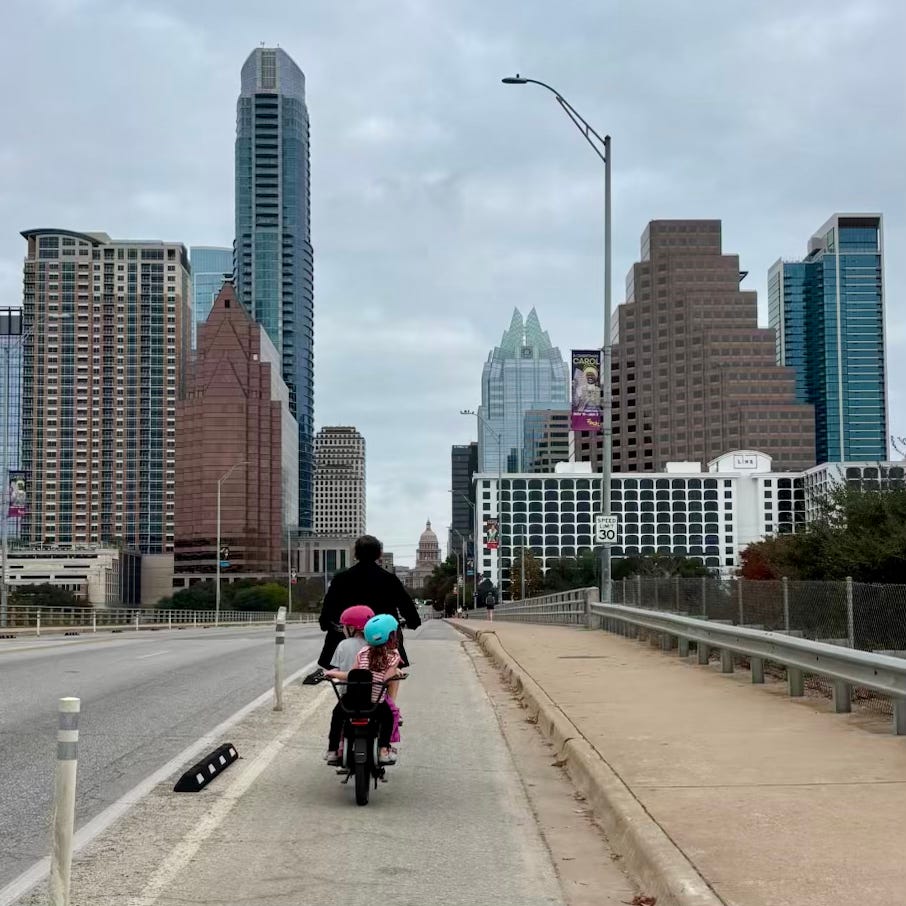
🤠 We’ve enjoyed a quiet Christmas week in Austin before we head to Colorado for a fun family ski trip. Wishing you a fantastic end to 2025 as we brace ourselves for whatever craziness 2026 has in store for us!
fun facts 🙌
I taught an octopus piano (it took 6 months). This Youtube creator has earned some high praise in the comment section: “I work as a behavioral neuroscientist and I can honestly, without hyperbole, say that this is genuinely cutting edge research. I mean it. I don’t know if you’re an academic or not outside of youtube, but if not I just want to be clear: you could earn a doctorate doing what you just did, I’ve read dissertations way dumber and way less relevant.” ~ learn more
The deepest hole on Earth. Dug by the Soviets in competition with the US, the Kola Superdeep Borehole is “roughly one-third of the way through the outer crust to the mantle.” Sounds deep, I guess, but is that really the best humanity can do? ~ learn more
Luxury wasp nests as home decor. Indoors, these nests transform into striking sculptures that “elevate living spaces” and convey an “air of danger,” according to Anthony Vesnaver of Newburgh Vintage Emporium. Priced up to $250, they’re an unexpected addition to chic interiors. ~ learn more
The Real Housewives of Moscow. Alina Rotenberg’s story provides a glimpse into the lives of Moscow’s élite women, who, while outwardly representing wealth and beauty, face fierce competition in the city’s "battle for men." “A man values a woman a lot more if she is constantly dragging presents out of him,” one learns at the Academy of Private Life, a place where women are taught strategies to capture rare marital commitment in a cutthroat environment. ~ learn more
tech, startups, internet ⚡
Google brings on the AI deflation. “Google’s latest model underprices the state of the art by 70% to 79%, with very similar levels of performance.” ~ learn more
What exactly is Production Capital? The term refers to “a wide and growing range of approaches for financing the emerging physical technologies aimed at transforming critical industries like energy, aerospace and defense, manufacturing, materials, and transportation.” This piece sketches a complex mosaic of emerging firms poised to deploy trillions in capital. ~ learn more
Stripe research confirms money helps grow businesses. A nearly two-year randomized trial revealed that businesses accepting loans from Stripe Capital “grew annual revenue around 27% faster.” Patrick Collison emphasizes this highlights the persistent issue of capital scarcity for many businesses. ~ learn more
Is it a bubble? Here’s how Howard Marks of Oaktree Capital sees it. “Memories are short, and prudence and natural risk aversion are no match for the dream of getting rich on the back of a revolutionary technology that ‘everyone knows’ will change the world.” ~ learn more
better doing 🎯
Thin desires consuming our lives. “We are living with a near-universal thin desire: wanting something that cannot actually be gotten, that we can’t define, from a source that has no interest in providing it.” Our modern world fuels these unsatisfying desires with technology, leaving true transformation and fulfillment in short supply. ~ learn more
to your health ⚕
Saltwater rinse and cold recovery. "Washing viruses out of your nose and throat can help you get better faster." In a trial with 66 adults, saline rinses shortened cold duration by nearly two days and reduced transmission at home. ~ learn more
retail therapy 💸
GenAI ads outperform human ones. "GenAI-created ads see 19% higher click-through rates than human-created ads." NYU and Emory researchers found that even product packaging influenced by Generative AI boosts creative performance. As usual, when AI usage was disclosed, it tanked performance. ~ learn more
The end of interchange. “Credit card companies have had a good run extracting interchange from merchants for the last forty years, but those days are coming to an end.” Fred Wilson’s a pretty good predictor of the future, but I don’t yet share this vision. ~ learn more
under the microscope 🔬
This frog knows its face. I’ve shared before about the discovery that tiny electrical fields help cells determine where a nose should be, for example. I can’t get enough of how cool this is. "Picasso tadpoles make largely normal frog faces. That’s amazing— all the organs start off in abnormal positions, yet they still end up making a pretty good frog face.” Michael Levin’s work suggests cellular ‘intelligence’ that challenges the blueprint view of DNA. ~ learn more
Algae as asphalt’s green hero. “Algae-derived compounds can improve moisture resistance, flexibility and self-healing behavior in asphalt, potentially extending pavement life and reducing maintenance costs,” says Assoc. Prof. Elham Fini. ~ learn more
Plants’ secret language revealed. Scientists have unraveled a century-old mystery of how plants communicate stress. “We are trying to build a foundational knowledge of understanding how communication in plants happens,” explains Vesna Bacheva. The study shows plants use negative pressure within their vasculature to send mechanical and chemical signals responding to stressors. ~ learn more
thoughts of food 🍔
Diet Coke’s ‘It Girl’ moment. Count me in for one! Yet, I refuse to let my kids try it. The soda has made a major comeback, embraced by Gen Z as the “fridge cigarette” for its refreshing qualities minus the nicotine. This nostalgic yet current appeal has positioned Diet Coke as a lifestyle brand, capturing a mix of “comfort and confidence.” ~ learn more
Chicago’s vegan scene contracts. In recent years, the city has witnessed a retreat in its plant-based dining options. “Despite the once-rising popularity of vegan and vegetarian cuisine, many establishments are now shuttering as diners return to traditional meats.” I sent this to a vegan friend and he replied: “I know!!!! It’s crazy!” ~ learn more
teaching the kids 👩🏫
Digital devices and education decline. “The standardized test scores of American students had been rising for decades. Then they began to slide, dropping to their lowest point in two decades in 2023 and 2024.” Devices like laptops and tablets may not be helping, as school-issued ones often allow distractions beyond educational use. ~ learn more
Marginal returns to public universities. “This paper studies the returns to enrolling in American public universities by comparing the long-term outcomes of barely admitted versus barely rejected applicants. … The typical marginally admitted student gains an additional year of education in the four-year sector, becomes 12 percentage points more likely to ever earn a bachelor’s degree, and eventually earns 8 percent more than their marginally rejected but otherwise identical counterpart.” Check out the appendix for interesting charts. ~ learn more