

my story 🚀
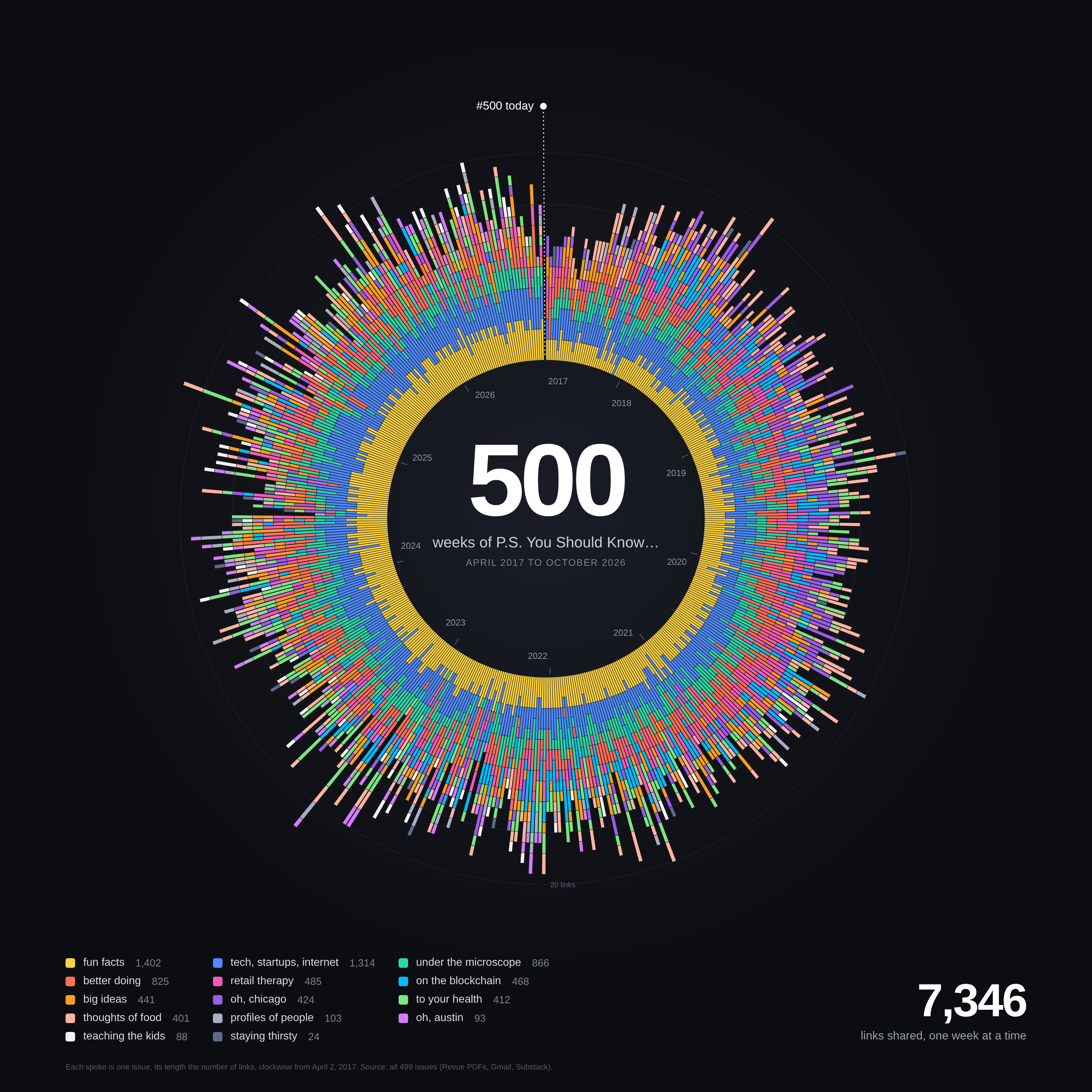
📧 When I set out on this newsletter project I had not considered that I might still be doing it 500 weeks later. One thing that hasn’t changed is my gratitude to you for allowing me into your inbox each week. It’s a great pleasure to be able to share my thoughts and interests with you. Enjoy!
fun facts 🙌
Democratizing AI pop songs. “Every image of her, the films, and everything needed to make her yourself. An open character: use her.” It’s a full kit for “Claudia,” an AI pop singer with strict visual canon (hair, streak, clip, mic) plus seven short films showing her across different worlds. ~ learn more
Slopcore music is getting catchy. Or maybe I’m just revealing something about my musical tastes. Know that it remains a craft and skill to make something good. Sharing my first try below as evidence that it’s easy to do, hard to do well. ~ learn more or check out a french one
SimCity but with building permits. “Permit Pending is a city simulation in the spirit of the classics, with one difference: you are not a god.” You’re an elected mayor trying to get housing, transit, and industry through “hearings, reviews, objections, lawsuits and appeals.” ~ learn more
How Thailand resisted colonization. Even in the 1800s the story about an invasion had to be sold to onlookers for legitimacy. “Mongkut’s discovery of the Stele was comparable to finding a lost Magna Carta at just the right moment.” Siam used the Ramkhamhaeng Stele as proof of a sophisticated literary and legal tradition, to make colonial “civilizing” pretexts harder to sell. ~ learn more
tech, startups, internet ⚡
Startups that run themselves. “The next great companies will run themselves, operations, code, and all.” Ultrametric is collecting the boring-but-essential founder processes and marking how “agentic” each one can be today. ~ learn more
Agents don’t click ads. “Agents don’t click ads. Who pays?” A discussion between Cloudflare CEO Matthew Prince and Nous Research CEO Dillon Rollnick. Dillon’s company makes the Hermes agent and Matthew’s protects a significant portion of internet traffic. They have a great dialogue about the agentic world we’re entering. ~ learn more
Financing the AI data supply chain. “I’m seeing more and more conversations about the need for financing in the emerging AI data supply chain.” Brandon Fryer maps old tools to new problems: purchase order financing, invoice factoring, A/R financing, and working capital lines of credit. ~ learn more
better doing 🎯
Most advice is right for the person giving it. “Two smart people can tell you opposite things, and both can make perfect sense.” The trick is to stop copying the rule and ask what was true about their situation, then check if it’s true for you too. ~ learn more
The courage to become who you already are. This piece quotes Joseph Campbell’s Hero’s Journey, which I recently read: “We must be willing to get rid of the life we’ve planned, so as to have the life that is waiting for us. The old skin has to be shed before the new one can come.” ~ learn more
under the microscope 🔬
Mini brain organoids “read” braille. “We can take information from a real tactile sensor, turn it into a form that a living neural network can receive, and then recover meaningful information from the organoid response,” says Tianyi Liu. In their setup, three mini forebrain organoids got braille-letter decoding up to 83% accuracy. ~ learn more
A signal deep in the brain that richly represents a stimulus you’re not aware of. Doris Tsao shares experimental evidence that your brain rapidly flips back and forth between conscious perception and unconscious processing. ~ learn more
Where do you draw the line. “Are mental health disorders real, distinct categories, or are the lines between them more arbitrary than we think?” Spencer Greenberg walks through why anxiety and depression so often travel together, and how newer frameworks like HiTOP try to replace crisp labels with better fitting dimensions. ~ learn more
teaching the kids 👩🏫
What to teach kids. “My economically valuable skillset, programming, suddenly feels less valuable. What shall I teach my son? And to what end?” A soon-to-be father reads Neil Postman and lands on a calmer thought: schools have survived every “this changes everything” wave before. ~ learn more